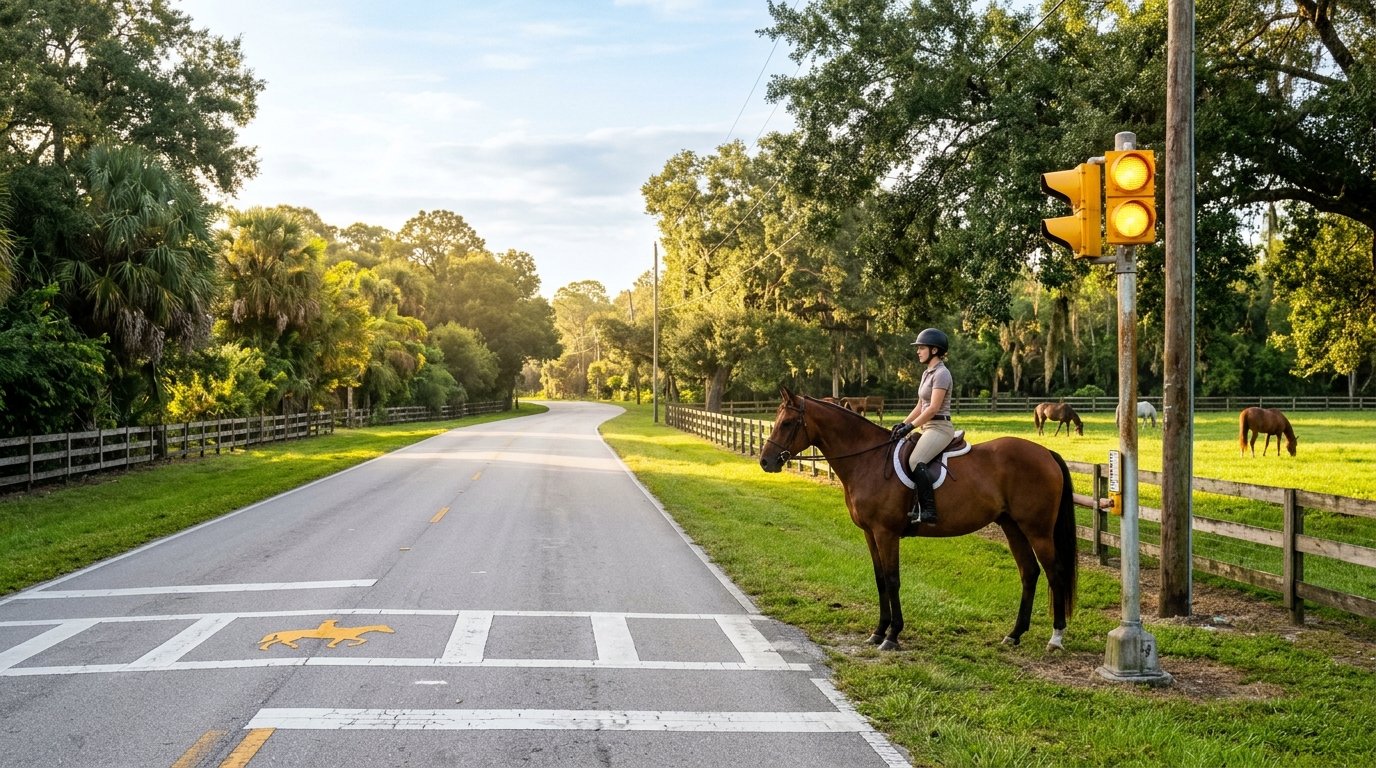
Riders in Loxahatchee Groves could soon have six new equestrian crossings on Okeechobee Blvd., one at each intersection from A Road to F Road, paid for by Palm Beach County. County officials presented the plan to the Town Council on Oct. 6, 2026, with installation targeted for December and January. Nearly everyone agrees safer crossings are overdue. The open question is who maintains them, and whether the town has to give up any of its hard-won control over the road to get them. Here's what's proposed and what each side has said.
The crossings at a glance
- Where
- Okeechobee Blvd. in Loxahatchee Groves, at each intersection from A Road to F Road
- What
- Six crossings, each with pavement striping, two solar rectangular rapid flashing beacons, two equestrian push buttons and two advance warning signs
- Who pays
- Palm Beach County installs them at no cost to the town
- Timing
- County officials expect installation to start in early December and finish in January
- Still to decide
- Whether the town maintains the equipment itself or signs an interlocal agreement for the county to do it
What the county is proposing
County Engineer David Ricks told the Town Council the plan came out of a search for a cheaper option after town leaders applied for a $1 million grant for equestrian trail projects, the Town-Crier reported. Instead of a large trail project, the county would install push-button flashing beacons built for riders at the six lettered-road intersections, where horses and riders cross a busy road.
Palm Beach County owns Okeechobee Blvd. and its right-of-way, but the Town of Loxahatchee Groves sets the speed limit and controls lane expansion. Today, the limit is 30 mph from A Road to F Road.
The maintenance question
Someone has to keep the beacons working. The town can maintain them itself, or sign an interlocal agreement that makes the county responsible for repairs. Without an agreement, the town would pay for any future problems with the equipment.
"These are pretty robust fixtures… but over a period of time, because of weather, you'll probably see some level of maintenance going to be required," Ricks said. "It's not going to be a lot, but someone needs to be tasked with that responsibility."
The case for moving ahead
- Rider safety. County Mayor Sara Baxter said equestrian crossings have been needed in the area for a long time, and the biggest obstacle has been funding. "We are just trying to find a way to have safer crossings for equestrian riders," she said.
- No cost to the town. The county would cover installation, and an interlocal agreement would also put repairs on the county.
- Proven equipment. Push-button rectangular rapid flashing beacons are a common tool at trail crossings. Wellington has used them at busy horse crossings such as Pierson Road near the Wellington International showgrounds.
- Fast timeline. If the town signs off, the crossings could be in before the heart of the winter season.
The case for caution
- Protecting local traffic control. "The fact that we have traffic control along Okeechobee Blvd. has been a saving grace for us in a lot of situations, as far as trying to keep it slow and two lanes," Councilwoman Anita Kane said.
- Residents want the town's say kept. One resident told the council the town should never give up its traffic control rights, saying slowing traffic down is one thing the town has done right for horses and agricultural vehicles.
- Narrow agreement, or none. An interlocal agreement could be written to cover only the crossings, leaving the town's speed and lane authority untouched. Baxter said the county isn't after more: "We are not trying to take traffic control."
- Long-term costs. If the town keeps maintenance in-house to avoid any agreement, it takes on repair costs for 12 beacons, 12 push buttons and 12 signs for years to come.
A familiar problem next door
Horse crossings are a constant balancing act out west. Wellington's Equestrian Preserve Committee heard in February that rapid flashing beacons at the busy Pierson Road crossing help, but some users assume the signals are already on and occasional detector glitches leave them flashing. An engineer proposed upgrading to a pedestrian hybrid beacon, or HAWK signal, which turns red so drivers have to stop, the Town-Crier reported. For more on how horse country is changing, see the Wellington International expansion and the debate over more RVs for grooms in Rustic Ranches.
What happens next
The Loxahatchee Groves Town Council will decide at a later meeting whether to handle maintenance itself or sign an interlocal agreement with the county. If it moves quickly, county staff expect installation to begin in early December.
What do you think?
Should Loxahatchee Groves take the county's free crossings and sign a maintenance agreement, or keep full control of the road and the upkeep? If you ride, what would make crossings on busy roads feel safer?
Frequently asked questions
Where are the new Loxahatchee Groves equestrian crossings?
On Okeechobee Blvd., one at each intersection from A Road to F Road, for six crossings in all.
Who is paying for the Okeechobee Blvd. equestrian crossings?
Palm Beach County would install them at no cost to the Town of Loxahatchee Groves. The town still has to decide whether to maintain them itself or sign an interlocal agreement for the county to do it.
When will the equestrian crossings be installed?
County officials said they expect installation to start in early December 2026 and be completed in January 2027.
What will each crossing include?
Pavement striping, two solar rectangular rapid flashing beacons, two equestrian push buttons and two advance warning signs.
Sources
- Town-Crier: Lox Groves Working With County On Equestrian Crossings (Oct. 16, 2026)
- Town-Crier: Equestrian Panel Discusses Trail Safety, Crossing Improvements (Feb. 20, 2026)
Details on developments and schools can change. We update this guide as new information is announced. Spot something out of date? Send us a tip.
Keep reading
More RVs in Rustic Ranches? Wellington's Latest Neighborhood Debate
Wellington's Equestrian Preserve Committee backed letting Rustic Ranches owners keep up to four RVs as grooms' housing. What's proposed, the rules, and both sides of the debate.
Wellington International Is Getting Bigger: What the Showgrounds Expansion Means for Neighbors
Wellington International South adds 98 acres, a 3,000-seat arena, a covered arena and new barns, bringing dressage next to WEF. How the deal works, the Equestrian Preserve trade-off and what both sides say.
Global Dressage Festival 2027 in Wellington: Dates, Friday Night Stars and Tips
Adequan Global Dressage Festival 2027 in Wellington, FL: week-by-week dates, CDI5* and World Cup qualifiers, Friday Night Stars freestyles, free admission and spectator tips.
Palm Beach Polo Season 2026 to 2027: Your Guide to the National Polo Center
The 2026 to 2027 Palm Beach polo season runs December 27 to May 2 at the National Polo Center in Wellington. Dates, the Gauntlet of Polo, first-timer tips and group seating.
Winter Equestrian Festival 2027: A Local's Guide to WEF
WEF 2027 runs January 6 to April 4 at Wellington International. Dates, when to go, spectator tips, traffic advice and where to eat during Wellington's horse show season.
Wellington and the County Reach a Narrower Deal on Artistry Lakes
Wellington and Palm Beach County negotiated a narrower boundary agreement covering only Artistry Lakes, dropping Arden. What's in the deal, the housing money, and the concerns that shaped it.