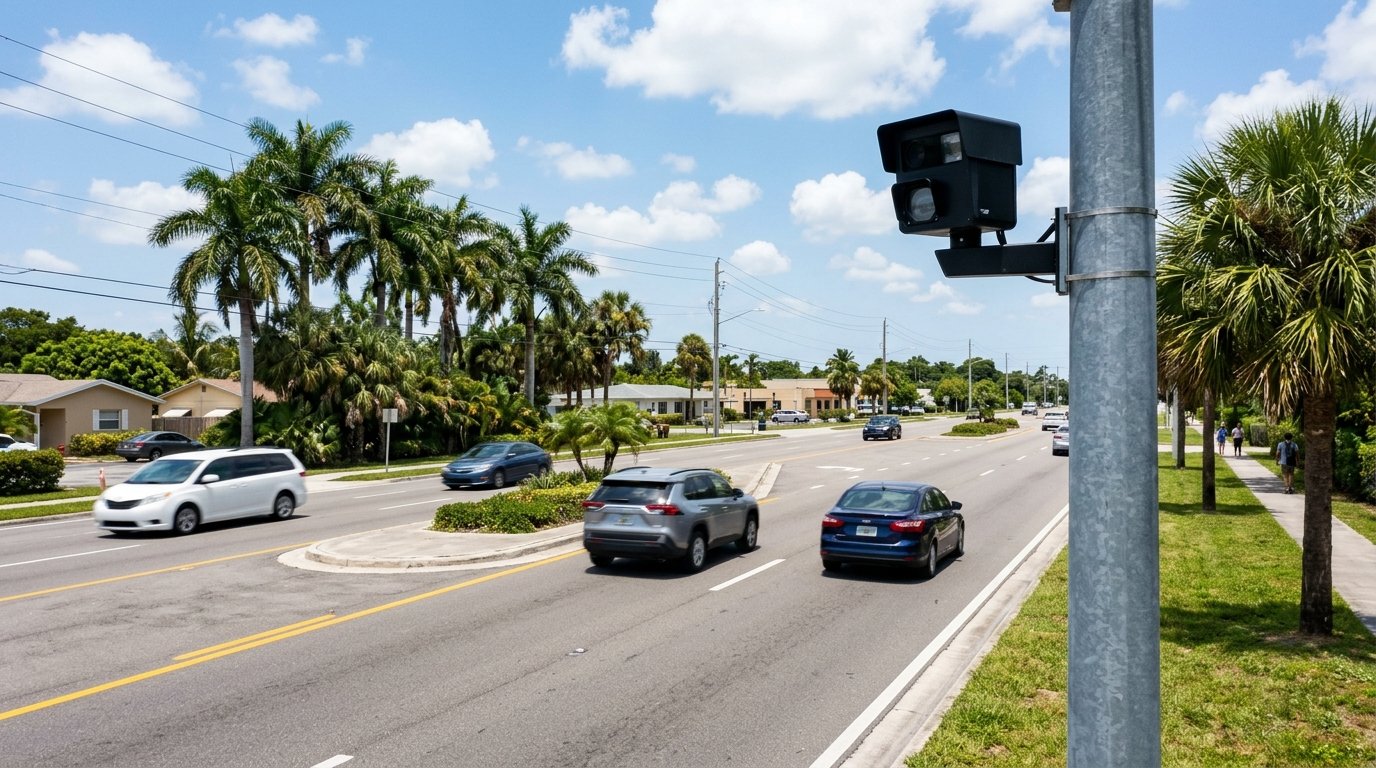
License plate reader cameras are a familiar sight on poles across Palm Beach County, and now the Palm Beach County Commission is taking a closer look at how they're used. At a Sept. 29, 2026 workshop, commissioners asked the Palm Beach County Sheriff's Office (PBSO) to answer questions about what the cameras collect and how the data is protected. Supporters say the readers are a valuable tool for catching criminals, with safeguards already in place. Commissioners worried about privacy want clearer answers first. Here's how the county's rules work and what each side has said.
License plate readers in Palm Beach County at a glance
- What they do
- High-speed cameras capture license plate images and convert them into digital data that law enforcement can use in investigations
- County approvals
- About 50 locations in county rights-of-way are in place or approved for installation
- Who can get a permit
- Only public police or sheriff's departments, and only for official law enforcement duties
- If rules are broken
- Permit holders have 30 days to remove the cameras or face a fine of $1,000 per day
- Status
- Commissioners asked PBSO to answer their questions before deciding whether any changes are needed
How the county's rules came about
In 2019, law enforcement asked the county for permission to install the readers in county rights-of-way, according to a staff presentation reported by the Town-Crier. Commissioners authorized permits with conditions, including that the cameras be used solely for law enforcement purposes. No permits were actually issued until 2022. Several cities and villages have also installed readers within their own boundaries.
The review comes amid national reports about possible misuse of the technology. Camera makers including Flock, Axon and Genetec have been at the center of those debates, and in Florida, Gov. Ron DeSantis recently ordered Flock cameras removed from state rights-of-way, the Town-Crier reported.
The question of what can be shared
In September, county officials asked every license plate reader permit holder for contract and data information. PBSO said it couldn't provide certain information publicly and suggested briefing commissioners individually or in a closed-door "shade" meeting. The county attorney's office advised that the request didn't meet the legal requirements for a shade meeting. "We haven't been personally made aware of any incidents with our permits, but we have read the headlines and seen some other cases," County Engineer Joanne Keller said.
The case for the cameras
- An investigative tool. Plate readers help law enforcement track vehicles tied to crimes, and even skeptical commissioners acknowledged their value. "It's a great tool for you guys to apprehend people who do things the wrong way," Commissioner Joel Flores told PBSO.
- Guardrails already exist. PBSO Major Thomas Fresneda said the agency runs weekly random audits looking for anomalies. "We have guardrails in place to make sure that, to the best we can, the system is not being misused," he said. "We've identified no misuse within the system."
- Targeted placement. Fresneda said PBSO mainly installs readers around critical infrastructure related to dignitary protection, with the rest within municipalities, and that there are "many misconceptions" about the technology.
- Strict permit terms. County permits already limit the cameras to police and sheriff's departments and carry steep daily fines for violations.
The case for caution
- Privacy for law-abiding drivers. Flores asked whether the cameras collect data beyond plates, such as who is driving and what they look like. "I don't think I should compromise my privacy for people who break the law," he said.
- Unanswered questions. Fresneda wasn't able to give definitive answers to many of Flores' questions at the workshop, and commissioners asked PBSO to follow up.
- Transparency. PBSO's position that some contract and data information can't be shared publicly left the commission without a full public picture of how the data is handled.
- A broader trend. The county is one of a growing number of local governments rethinking plate readers after national reports of misuse.
What happens next
Commissioners are waiting on PBSO's answers. Depending on what they learn, they'll weigh residents' privacy against the readers' value as an investigative tool. For how a neighboring city is using similar technology, see Westlake's speed cameras and license plate readers, and for Wellington's own camera program, one year of school zone speed cameras.
What do you think?
Do license plate readers make Palm Beach County safer, or do they collect too much information about everyday drivers? What rules would make you comfortable with them?
Frequently asked questions
How many license plate readers has Palm Beach County approved?
About 50 locations in county rights-of-way have license plate reader approvals that are either in place or approved for installation, according to a county staff presentation in September 2026.
Who can get a permit for a license plate reader in county rights-of-way?
Only public police or sheriff's departments, and only to support their official law enforcement duties.
What happens if a permit holder breaks the county's rules?
The permit holder has 30 days to remove the license plate readers or faces a fine of $1,000 per day.
Has PBSO found misuse of its license plate reader system?
PBSO Major Thomas Fresneda told commissioners the agency runs weekly random audits and has identified no misuse within the system.
Sources
Details on developments and schools can change. We update this guide as new information is announced. Spot something out of date? Send us a tip.
Keep reading
Loxahatchee Groves Keeps Its Tax Rate After a Tense Budget Fight
Loxahatchee Groves kept its tax rate at 3.2564 mills, 9.52 percent above rollback, in a 4-1 vote after a long hearing. What the budget funds, how the deal came together, and both sides.
Why Your Wellington Water and Trash Bills Are Going Up
Wellington raised its solid waste assessment by $5 per unit and water and sewer bills by an average $4.79 a month for 2026-27. Why, what the money pays for, and what council members said for and against.
Three County Ballot Questions: What Wellington Voters Are Deciding on Schools, Parks and Libraries
The Nov. 3, 2026 ballot asks Palm Beach County voters to continue the 1-mill school tax and approve $280 million in parks bonds and $175 million in library bonds. What each costs, what it funds, and what both sides say.
Wellington and the County Reach a Narrower Deal on Artistry Lakes
Wellington and Palm Beach County negotiated a narrower boundary agreement covering only Artistry Lakes, dropping Arden. What's in the deal, the housing money, and the concerns that shaped it.
Palm Beach County's Proposed E-Bike Rules: Age 14, Photo ID and Speed Limits
Palm Beach County gave first approval to e-bike and scooter rules: minimum age 14, photo ID, 15 mph on paths and a $64.50 fine. What's in it, how it compares with Wellington, and both sides.
Where to Vote Early Near Wellington for the Nov. 3, 2026 Election
Early voting in Palm Beach County runs through Sunday, Nov. 1, 7 a.m. to 7 p.m. The sites closest to Wellington, what ID to bring, vote-by-mail deadlines and Election Day info.