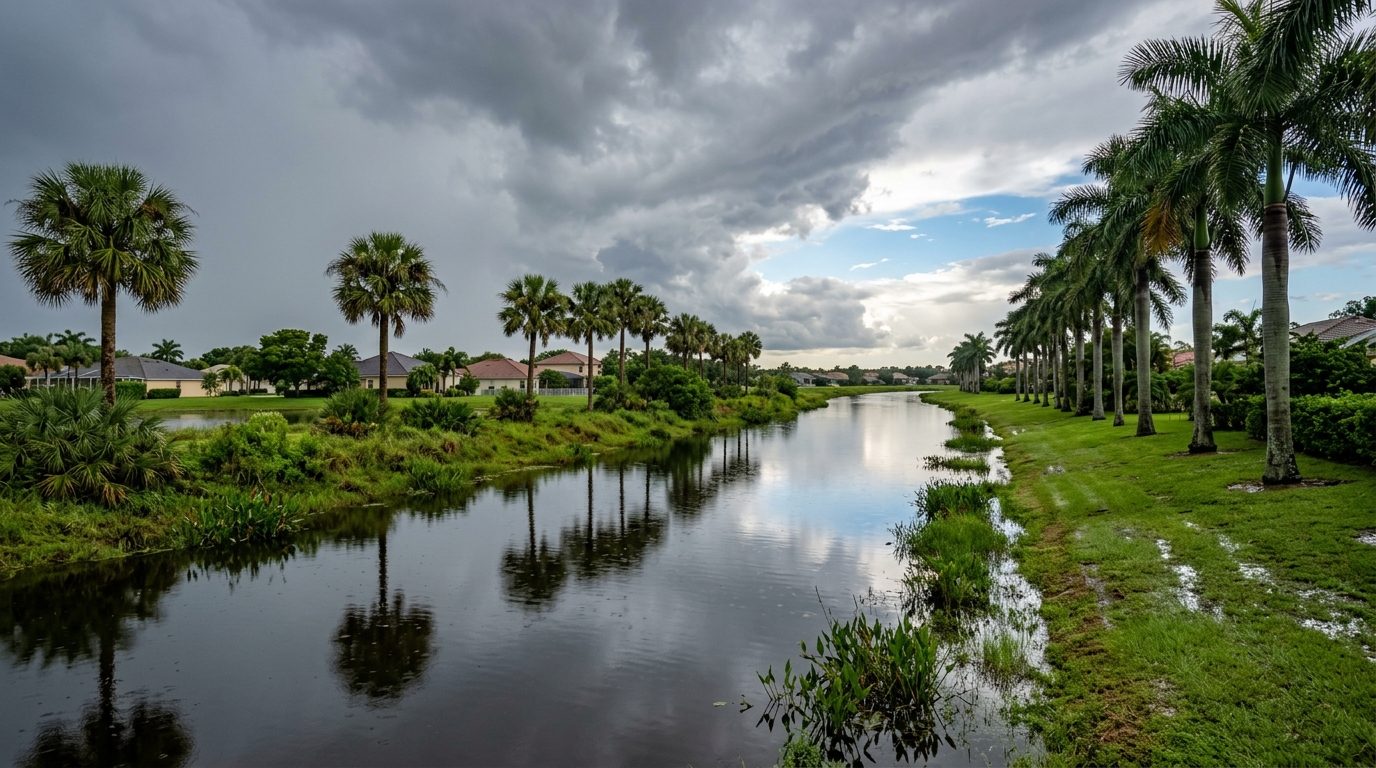
Record rain hit Palm Beach County on Nov. 1-2, 2026, flooding neighborhoods in West Palm Beach and Riviera Beach and moving several Election Day polling places. West Palm Beach got 7.39 inches on Nov. 2 alone, a daily record, and 11.67 inches over two days, according to the National Weather Service via the city. If you're searching for "Wellington FL flooding," here's what happened across the county, how Wellington's drainage system is designed to handle big storms, where flood help is available, and what to do before the next one.
Palm Beach County flooding at a glance
- When
- Nov. 1-2, 2026, with more rain into Election Day, Nov. 3
- Rainfall
- West Palm Beach: 7.39 inches on Nov. 2 (old record 2.52 inches, 1925) and 11.67 inches over Nov. 1-2
- Hardest hit
- Neighborhoods in suburban West Palm Beach near Haverhill Road and in Riviera Beach, where about 75 residents were evacuated from the Lone Pine area
- Emergency status
- Palm Beach County's state of local emergency was extended another week as of Nov. 9
- Help center
- Multi-Agency Resource Center at Wells Recreation Center, 2409 Avenue H West, Riviera Beach, 7 a.m.-7 p.m., opening Nov. 10 for about 14 days
- Wellington drainage
- Run by the Acme Improvement District: (561) 791-4000
What happened
An extraordinary rain event on Nov. 1 and 2 overwhelmed stormwater systems in parts of eastern and northern Palm Beach County, CBS12 reported. The City of West Palm Beach said the two-day total of 11.67 inches was more than three times its average rainfall for all of November, and that parts of northern Palm Beach County may have exceeded thresholds associated with a 1-in-1,000-year rainfall event, based on preliminary reports.
- West Palm Beach: Residents in the Gramercy Park area near North Haverhill Road and 45th Street waded through 2 to 3 feet of water, and neighborhoods such as Foxhall and Visions at Willow Pond off Haverhill Road were cut off, WPBF and CBS12 reported.
- Riviera Beach: About 75 residents were evacuated from the Lone Pine area, and the city ran pumps to move water into canals.
- Election Day: The Supervisor of Elections relocated several polling places in Riviera Beach and Mangonia Park because of flooding.
- The region: Okeechobee, Martin and St. Lucie counties also reported significant damage, with preliminary damage in Okeechobee County topping $10 million, WPBF reported on Nov. 9.
By Nov. 9, much of the water in Palm Beach County had receded, but some neighborhoods were still cleaning up, and the county's local state of emergency was extended another week.
What about Wellington?
The worst flooding reported in the news was in eastern and northern parts of the county, not in Wellington. We did not find reports of widespread flooding in the village from the Nov. 1-2 storms, but heavy rain can still cause standing water on streets, swales and low-lying yards anywhere. If you saw flooding on your street or property, report it to the village (contacts below) so crews know where problems are.
How Wellington's drainage system works
Most of Wellington's flood protection comes from the Acme Improvement District, a special district the Florida Legislature created in 1953 to handle drainage and water management in this part of western Palm Beach County. When Wellington incorporated in 1995, Acme became a dependent district of the village, and the Village Council serves as its Board of Supervisors. Acme's service area covers more than 32 square miles.
Here's how the system works, according to Acme:
- Canals and lakes store water. Wellington's canals, lakes and swales hold stormwater and move it toward pump stations.
- Pump stations push water out. Acme operates a network of stormwater pump stations, including Pump Stations 3 and 4, which discharge to the South Florida Water Management District's C-51 West Canal, and Stations 7, 8 and 9 along Flying Cow Road. Many individual pumps move 45,000 to 62,000 gallons per minute, and stations have backup generators.
- Water levels are lowered before storms. Before a big storm, staff can "draw down" canal levels to create extra storage, then use gates and pumps after the storm to shorten flooding. Pumps and gates can be monitored and operated remotely by radio telemetry.
- Permitted target levels. In Basin A, Acme's permit calls for keeping canals and lakes at about 11 feet NGVD in the wet season and 12 feet in the dry season.
- Cleaning the water. Stormwater from Acme's Basin B flows through the Wellington Environmental Preserve, a 365-acre wetland, and then a state treatment area before reaching the Everglades.
Acme is funded by non-ad valorem assessments, which are based on the benefit to each property rather than its value, and it reports a $7.4 million budget with no debt.
Why flooding happens in Palm Beach County
Palm Beach County is flat, low-lying and heavily developed, and it gets frequent intense rain and periodic tropical storms, according to the county's Office of Emergency Management. Local flooding usually comes from flash flooding, when intense rain outpaces drainage, or from water levels building up over days of rain. Rainfall intensity and duration, the ground and how full canals already are all play a part.
Where to get help and report problems
- Flood recovery help: A Multi-Agency Resource Center opened Nov. 10 at the Wells Recreation Center, 2409 Avenue H West, Riviera Beach, from 7 a.m. to 7 p.m., expected to run about 14 days. Agencies include Palm Beach County Emergency Management, the Florida Department of Children and Families, the U.S. Department of Veterans Affairs and the American Red Cross, WPBF reported.
- Wellington drainage and canals: Acme Improvement District, 12300 Forest Hill Blvd., (561) 791-4000.
- Missed trash or debris pickup in Wellington: Wellington Solid Waste, (561) 791-4003.
- Water damage cleanup: see our list of water damage and mold restoration companies serving Wellington.
How to protect your home before the next storm
- Check your flood risk. Several residents in flooded neighborhoods told WPBF they didn't think they were in a flood zone and had no flood insurance. Look up your property on FEMA's Flood Map Service Center at msc.fema.gov.
- Consider flood insurance. Standard homeowners policies generally don't cover flood damage, and National Flood Insurance Program policies usually have a 30-day waiting period before they take effect, according to FEMA's FloodSmart site. Buy before you need it.
- Keep drains clear. Clear leaves and debris from storm drains, gutters and swales near your home.
- Never drive through standing water. Officials repeatedly urged residents to avoid flooded roads and never drive through standing water.
- Document damage. Take photos and video before cleanup for insurance and any assistance applications.
Hurricane season runs through Nov. 30. For more local guides, see living in Wellington: pros and cons and our earlier look at flooding and drainage in The Acreage.
What do you think?
Did your Wellington neighborhood see standing water during the early November storms? How did the drainage hold up on your street? Share what you saw so neighbors know what to watch for.
Frequently asked questions
Did Wellington, FL flood in November 2026?
The worst flooding from the record Nov. 1-2, 2026 rain was reported in eastern and northern Palm Beach County, including suburban West Palm Beach and Riviera Beach. We did not find reports of widespread flooding in Wellington, though heavy rain can cause localized standing water anywhere.
How much rain fell in Palm Beach County on Nov. 2, 2026?
West Palm Beach recorded 7.39 inches on Nov. 2, breaking the 1925 daily record of 2.52 inches, and 11.67 inches over Nov. 1-2, according to the National Weather Service via the City of West Palm Beach.
Who handles drainage and canals in Wellington?
The Acme Improvement District, a dependent district of the Village of Wellington, runs Wellington's canals, lakes and stormwater pump stations. Contact it at (561) 791-4000.
Where can Palm Beach County flood victims get help?
A Multi-Agency Resource Center opened Nov. 10, 2026 at the Wells Recreation Center, 2409 Avenue H West, Riviera Beach, from 7 a.m. to 7 p.m., with state, local and nonprofit agencies including the American Red Cross.
Does homeowners insurance cover flooding in Florida?
Standard homeowners policies generally don't cover flood damage. National Flood Insurance Program policies usually have a 30-day waiting period, so buy coverage well before storms.
Sources
- CBS12: Record rainfall floods Palm Beach County neighborhoods
- WPBF: Palm Beach County neighborhoods submerged
- WPBF: Flood assessments underway
- Acme Improvement District: What is Acme?
- Acme Improvement District: Surface Water Management
- Palm Beach County OEM: Types and Causes of Flooding
- FloodSmart (FEMA)
Details on developments and schools can change. We update this guide as new information is announced. Spot something out of date? Send us a tip.
Keep reading
Thanksgiving in Wellington 2026: Holiday Hours, Trash Pickup and Turkey Trots
Thanksgiving 2026 in Wellington, FL: no trash pickup Nov. 26, village facility and park holiday hours, library closures, nearby turkey trots and what's open.
Wellington Branch Library Guide: Hours, Library Card, Programs and Meeting Rooms
Wellington Branch Library guide: hours, holiday closures, how to get a free Palm Beach County library card, programs, meeting and study rooms, and free services.
13 Best Gyms and Fitness Studios in Wellington, FL
The best gyms and fitness studios in Wellington, FL: Crunch, YouFit, Planet Fitness, Orangetheory, CrossFit, Club Pilates, JETSET, 9Round, the Aquatics Center and more, with hours and addresses.
15 Best Things to Do in Wellington, FL
The best things to do in Wellington, FL: the Winter Equestrian Festival, polo, Peaceful Waters, the Environmental Preserve tower, free amphitheater concerts, the new aquatics center, Lion Country Safari and more.
How to File for the Homestead Exemption in Palm Beach County
How to apply for the homestead exemption in Palm Beach County: who qualifies, documents you need, the March 1 deadline, the three ways to file, and how Amendment 3 raises the exemption starting in 2027.
Can You Run a Business From Your Wellington Home? What Florida Law Allows
Florida's 2021 home-based business law limits how cities can restrict businesses run from homes. What it allows (employees, parking, appearance), how HOAs fit in, a recent Royal Palm Beach example, and both sides of the debate.