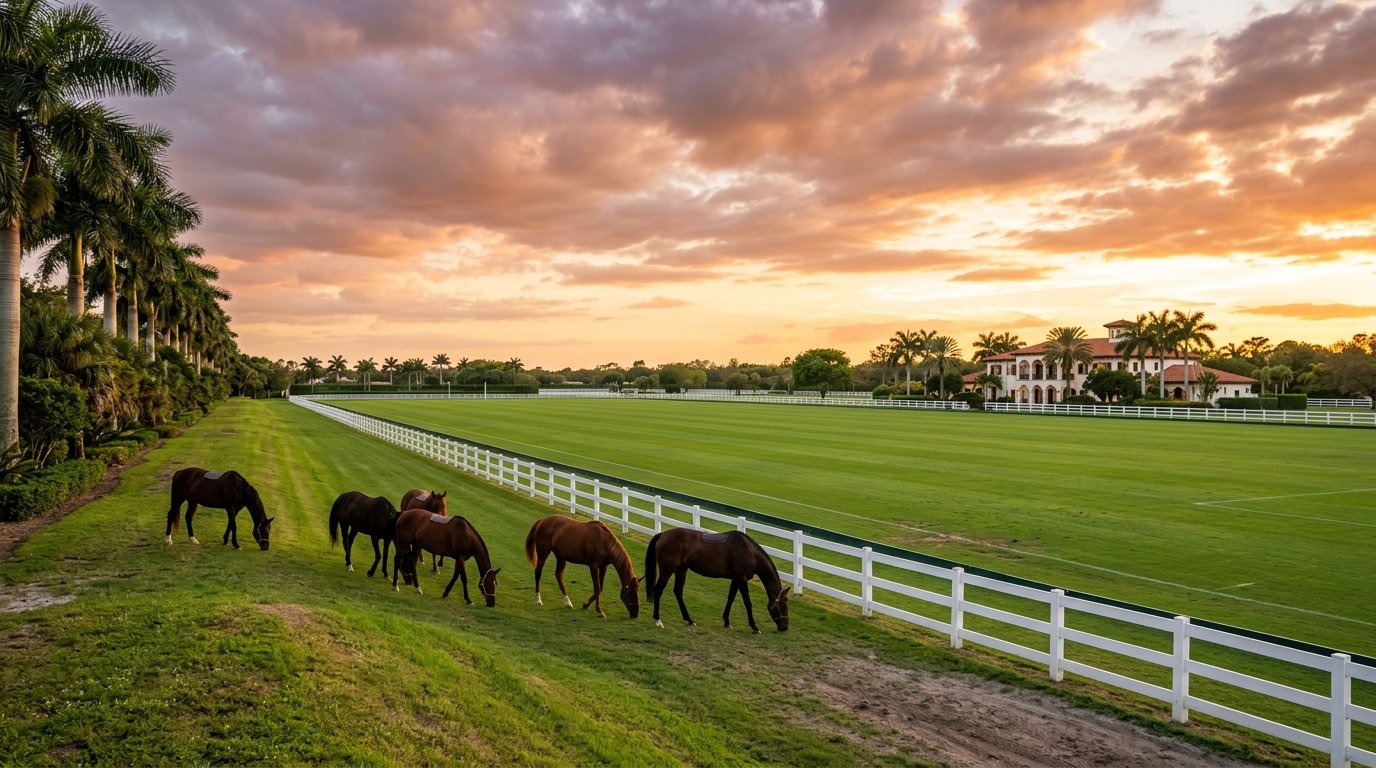
A billionaire, a beloved polo field, a private club for hundreds of families and a lawsuit against the Village. The fight over the Isla Carroll polo field on 120th Avenue South has become one of the biggest land-use battles in Wellington, and it raises a question many locals are now debating: did the Village protect the Equestrian Preserve, or did it turn down a deal that might have been better than the alternative? Here's what happened, what each side argues, and what could come next.
The fight at a glance
- The land
- About 79 acres at 3665 120th Avenue South, home to the Isla Carroll East polo field, in Wellington's Equestrian Preserve
- Who wanted to build
- McCourt Partners, led by billionaire Frank McCourt, and Discovery Land Company
- The final plan
- 27 homes, an 8-acre private club for 325 families, a barn and equestrian complex, and the polo field preserved under a 45-year U.S. Polo Association lease
- The decision
- Denied by the Village Council in February 2026, with Vice Mayor Tanya Siskind the only supporter, and denied again in March
- Now
- The property owner sued the Village on March 26, 2026; the claims have not been decided in court
What was proposed?
McCourt Partners and Discovery Land Company, a developer known for private club communities, asked Wellington to rezone the Isla Carroll property from Residential Equestrian to an Equestrian Planned Unit Development. The version the Village's Equestrian Preserve Committee reviewed in January 2026 called for 40 homes on smaller lots plus a roughly 31-acre club area with an equestrian complex, sports facilities and membership capped at 300 families.
After pushback, the developers came back with a smaller plan. According to The Real Deal, the revised version included:
- 27 homes, four of them on 2-acre lots meant for equestrian use, about a third less dense than the original
- An 8-acre private club for 325 families with a gym, racquet courts, a pool, dining and retail
- A 10-stall barn, an equestrian complex, bridle paths and shared paddocks
- The polo field preserved for the U.S. Polo Association through a 45-year lease
The developers said cutting the number of homes cost them about $30 million. McCourt called the project "a passion project of mine."
How the Village voted
The plan struggled at every step. Wellington's Equestrian Preserve Committee recommended denial in October 2025, the Planning, Zoning and Adjustment Board was wary of the project, and in January 2026 the committee voted unanimously against the 40-home version. In February 2026, the Village Council rejected the revised plan in a late-night vote, with Vice Mayor Tanya Siskind the only member in support. A second written denial followed in March after the developers tried again.
Mayor Michael Napoleone said the project wasn't centered on equestrian use, which conflicts with the Village's comprehensive plan, and that the country club appeared to be the focus. The Village's attorney noted there is "no absolute right to a rezoning."
The case for and against
What critics said
- Too much club, not enough horse. At committee hearings, critics argued that too much land went to clubhouse uses like a spa, dining and courts, and too little to permanent equestrian facilities. Some called the equestrian elements window dressing for a private club.
- A precedent for the Preserve. Committee members worried that approving clustered homes around private clubs could gradually replace Wellington's traditional large-lot horse farms, and they pushed for a clear definition of the "equestrian lifestyle" the code refers to but never defines.
- Practical questions. Speakers raised concerns about horse care, paddock space, bridle trail connections and traffic on 120th Avenue South.
What supporters said
- It saves the polo field. The plan locked in the USPA polo field for decades, which ordinary lot-by-lot development wouldn't guarantee.
- More access to horses. Supporters said a professionally managed club could give families without big private farms a way into the equestrian lifestyle, and pointed to Discovery's track record with high-end communities.
- The alternative could be worse. Under current zoning, the owner can build up to 40 single-family homes on 2-acre lots, with no requirement to keep the polo field. The developers' attorney called their plan a "low-density project that complies with the equestrian lifestyle."
The lawsuit
On March 26, 2026, the property owner, 120th Avenue S, LLC, sued the Village in Palm Beach County Circuit Court, according to the Boca Post. The complaint argues that Wellington misread its own comprehensive plan by treating development in the Equestrian Preserve as needing to be primarily equestrian, says the Village adopted a new interpretation of its equestrian policies in February 2026, and points out that Wellington approved a similar mix of homes and equestrian features in early 2024. It asks a judge to order the Village to grant the rezoning. These are the plaintiff's claims and have not been proven in court.
Before the council vote, the developers' attorney also said they could pursue more than $100 million in lost property value and legal fees under Florida's Bert J. Harris Jr. Private Property Rights Protection Act, a state law that lets owners seek compensation when government action places an inordinate burden on their property.
Why this one matters
Isla Carroll lands in the middle of a bigger debate about how much the Equestrian Preserve should change. In 2024, the Council approved Mark Bellissimo's luxury communities and removed about 96 acres from the Preserve, now known as The Wellington. Supporters of the Isla Carroll plan see the denial as inconsistent; opponents see it as the Village finally drawing a line. Either way, the outcome of the lawsuit could shape what gets built on Wellington's remaining horse land for years.
What do you think?
Was the Council right to say no, or would 27 homes and a protected polo field have beaten 40 homes and no guarantee? We'll update this story as the case moves through court. Have a take? Send it to us. For more on the area, see our guides to equestrian Wellington and the 2027 polo season.
Frequently asked questions
What is the Isla Carroll polo field fight in Wellington?
McCourt Partners and Discovery Land Company proposed rezoning about 79 acres at 3665 120th Avenue South for homes, a private club and an equestrian complex while preserving the Isla Carroll East polo field. The Village Council denied the plan in February 2026.
Who is behind the Isla Carroll project?
McCourt Partners, led by billionaire Frank McCourt, and Discovery Land Company, a developer of private club communities.
Why did Wellington deny the Isla Carroll plan?
Mayor Michael Napoleone said the project wasn't centered on equestrian use and conflicted with the Village's comprehensive plan. Critics argued too much land went to club amenities rather than horses.
Is there a lawsuit over Isla Carroll?
Yes. On March 26, 2026, the property owner, 120th Avenue S, LLC, sued the Village claiming it misinterpreted its comprehensive plan. The claims have not been decided in court.
What can be built on the Isla Carroll land without approval?
Under current zoning, the owner can build up to 40 single-family homes on 2-acre lots, with no requirement to keep the polo field.
Sources
- The Real Deal: Wellington rejects Frank McCourt's polo field redevelopment plans (Feb. 2026)
- Boca Post: Developer files suit challenging Wellington rezoning denial (Mar. 2026)
- Town-Crier: Wellington Council refuses latest proposal from Isla Carroll developers (Mar. 2026)
- Town-Crier: Developers file lawsuit against Wellington over Isla Carroll denial (May 2026)
- CitizenPortal: Wellington committee unanimously denies Isla Carroll rezoning
- Town-Crier: Wellington's zoning board wary of Isla Carroll project (Nov. 2025)
Details on developments and schools can change. We update this guide as new information is announced. Spot something out of date? Send us a tip.
Keep reading
Wellington and the County Reach a Narrower Deal on Artistry Lakes
Wellington and Palm Beach County negotiated a narrower boundary agreement covering only Artistry Lakes, dropping Arden. What's in the deal, the housing money, and the concerns that shaped it.
Artistry Lakes: Wellington and the County Clash Over a 446-Acre Annexation
Wellington annexed the 446-acre Artistry Lakes site on Southern Blvd., where Kolter Homes plans 579 homes. Palm Beach County objects and rejected a settlement. What happened, both sides, and what's next.
Golf Courses to Homes: How the Infill Law Is Hitting the Western Communities
Florida's Infill Redevelopment Act could turn closed golf courses like Wellington's Polo West into homes without public hearings, and Royal Palm Beach's Village Golf Club is next in line. How it works and both sides.
Data Centers Near Wellington? Palm Beach County's Moratorium Explained
Palm Beach County approved a one-year moratorium on large AI data centers after the Project Tango fight near 20-Mile Bend and Arden. What it covers, what's still possible on the Tango site, and both sides.
Could Polo West Become Homes? What a New State Law Means
BH Group bought Wellington's shuttered 150-acre Polo West Golf Course and plans luxury homes. How Florida's Infill Redevelopment Act could skip public hearings, and both sides of the debate.
Affordable Apartments Are Coming to Wellington Under the Live Local Act
Wellington's first Live Local Act apartments are planned on Van Gogh Road and Velazquez Blvd near Southern and Seminole Pratt, with rents of about $1,249 to $2,310. How the state law works and the fee-waiver debate.